Mountain bike GPS and computers, wired or wireless




Starting at £103.56
£101.33


A mountain bike GPS guides you on the trails by following a downloaded route, shows the climbing still to come and records your ride, whereas an MTB computer simply gives your speed and distance. Compare the mapping, the battery life and how easy it is to read with gloves on. Displays and trackers for electric mountain bikes are also on this page.
What should you expect from an MTB GPS?
In mountain biking, navigation happens off the road: poorly waymarked trails, junctions of forest tracks, routes whose surface changes from one mile to the next. A mountain bike GPS must therefore display a map that shows the paths, follow a route prepared in advance and flag any deviation. It must also withstand knocks, mud and rain, stay readable in bright sun as under the trees, and last a whole day without recharging. A simple MTB computer, wired or wireless, is still worthwhile if you only want to know your speed, distance and ride time.
Maps and routes: navigating on the trails
Most mountain bike GPS units accept routes in GPX format, which you prepare on a hiking website or app, or obtain from a club or the organiser of a mountain bike event. Synced with your phone, the route appears on the map, and the device warns you as you approach a turn or if you leave the course. On a model without maps, only the line of the route is shown: that is enough for a familiar route, trickier if you want to improvise. Finally, check that the preloaded map covers the area where you ride and distinguishes unpaved paths.
Altitude, climbing and sensors
Elevation gain is the key figure in mountain biking. A barometric altimeter measures changes in air pressure and gives a steadier altitude than satellite calculation alone, especially under tree cover. Some devices also break down every climb ahead on a loaded route, with its length and gradient. Over Bluetooth or ANT+, the GPS connects to a heart rate strap, a cadence or speed sensor, and sometimes to the assistance system of an electric mountain bike.
Toughness, battery life and mounting
Go for proven waterproofing, such as IPX7, and physical buttons if you often ride with wet gloves: a touchscreen remains handy for moving around the map, less so in the mud. For long rides and multi-day events, the stated battery life should cover your day with a margin. On a mountain bike, mount the device on the stem or near the centre of the handlebar, where it is best protected in a crash; MTB computer mounts gather the suitable fittings.
Electric mountain bikes: displays and GPS trackers
On an electric mountain bike, the display is linked to the motor: it sets the assistance level, shows the battery charge and can only be replaced by a model compatible with the same system. GPS trackers, on the other hand, hide inside the bike and connect to its power supply: if the bike is moved without authorisation, they send an alert to your phone and let you locate the bike. They complement a good lock without replacing it.
Watches, lights and computers for other riding
A GPS watch can act as your GPS if you also run, and MTB lights complete your kit for night rides. If you also ride on the road, compare with GPS bike computers for road cycling or the full range of bike computers and GPS units.
Which MTB GPS and computer brands should you choose?
Brose, an e-bike motor maker, offers the Allround, a handlebar remote with a built-in 1.5-inch colour screen, which can be mounted on the left or the right and is compatible with all bikes fitted with a Brose Drive motor.
Powunity, a company from Innsbruck, in Austria, houses its BikeTrax tracker in the motor casing of Bosch, Brose, Shimano or Yamaha electric bikes; powered by the bike's battery, it has its own reserve when that battery is removed.
Sigma fits its ROX 4.0 Endurance with a barometric altimeter, GPS and GLONASS reception and IPX7 waterproofing; the brand also offers simple computers, such as the BC 12.0 and BC 14.0, wired or wireless.
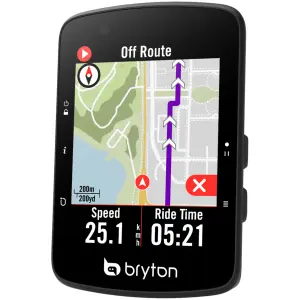
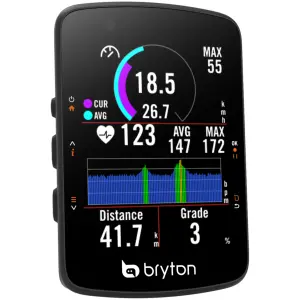
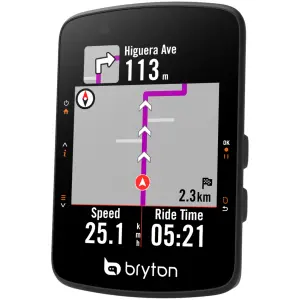
Bryton has given its Rider S800 and S810 a colour touchscreen, turn-by-turn navigation with automatic rerouting and real-time climb tracking.
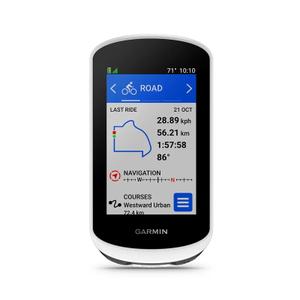
Garmin designs the Edge Explore 2 for navigation: maps that show unpaved paths, routes imported from several route-planning apps and the ClimbPro feature, which details the climbs still to come.
MTB GPS and computers on sale
A replaced generation often moves a GPS into the MTB electronics outlet; recently arrived devices are listed in new arrivals. During the winter sales, you can choose a GPS at leisure, before the mountain bike events start again.
Frequently asked questions
Touchscreen or buttons: which is better for mountain biking?
Buttons respond with thick gloves, in the rain and in the mud, and trigger nothing by mistake on a rough descent. A touchscreen makes it easier to move around the map and enter a destination. Many mountain bikers prefer buttons; some models combine both.
How much battery life do you need from an MTB GPS?
Allow at least the length of your longest rides, plus a margin: navigation with maps, the backlight and connected sensors use more power. For multi-day trips, a power-saving mode or a small power bank in your pack makes the difference.
How do you get a GPX route onto your mountain bike GPS?
Plan the route in a mapping app, or download the route published by a tourist office, a club or an event organiser. Then send it to the GPS through the manufacturer's app or by cable. Check on the map that the route follows paths open to mountain bikes.
How do you protect your GPS in a crash?
Mount it set back, on the stem or in the centre of the handlebar, rather than out in front on an extended mount. A silicone case protects the screen and the casing from spray and light knocks, and a safety lanyard stops you losing the device if the mount breaks.
Does a GPS tracker protect an electric mountain bike from theft?
It does not prevent theft, but it alerts you as soon as the bike moves and lets you follow its position to recover it with the police. Hidden in the motor, it escapes a thief in a hurry. It should always be combined with a strong lock.