Complete gravel group, mechanical or electronic


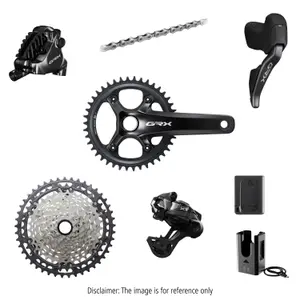


Starting at £1,099.93
£866.53


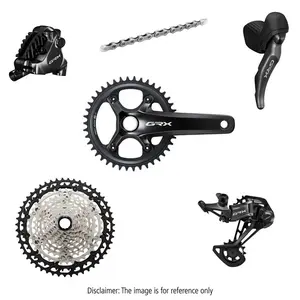


A gravel group includes levers, derailleurs, cranks, cassette and chain designed for paths: smaller chainrings than road, more stepped cassette and stabilised rear derailleur. First choose between single and double chainring, then between mechanical and electronic shifting. Road and MTB groups are also on this page, for gravel bikes aimed at tarmac or fitted with flat handlebars.
What distinguishes a gravel group?
A gravel group keeps the levers of a road bike, but everything else is tailored for the trails. The chainrings are smaller and the cassette has a wider range, allowing for seated climbing on a rocky ascent with a bike that is sometimes loaded with panniers. The rear derailleur includes a stabiliser that reduces chain slap on the stones. The levers are designed to keep hands on the hoods, the most common position on the paths: with Shimano, the GRX levers have a pivot placed higher and a textured coating to maintain grip. Finally, the crankset keeps the chain away from the frame, making room for wide tyres.
Single or double chainring: the configurations of a gravel group
This choice structures the entire group, as it determines the rear derailleur, the cassette, and whether a front derailleur is needed. The Shimano GRX with 12 speeds gives a good example:
- Single chainring 10-51: a 40 or 42-tooth chainring, a long cage derailleur, and the widest gear range for mountains, touring, and steep trails.
- Single chainring 10-45: the same chainring, a medium cage, and slightly finer gaps between the sprockets for rolling gravel.
- Double chainring 48/31: an 11-34 or 11-36 cassette and a front derailleur, for tight gaps on the road as well as on paths.
The single chainring eliminates one control and some parts to adjust, and holds the chain better. The double chainring avoids cadence jumps between two sprockets and appeals to those who ride in groups or tackle long stretches of tarmac.
Mechanical, Di2 or wireless: which control on the trails?
A mechanical group, like the GRX 820, shifts gears using cables. It can be repaired at the side of the trail with a wrench and a spare cable and does not rely on any battery, a plus for long-distance touring. However, it does require regular tension adjustment, as water and mud can eventually gunk up the cables.
An electronic group maintains consistent shifting regardless of conditions. The GRX 825 Di2 combines wireless levers with derailleurs connected via a wire to a single battery; with Sram, the AXS system removes all wires, with each derailleur having its battery. Be sure to recharge before a multi-day crossing.
Road or MTB group on a gravel bike?
This page also includes road groups Shimano Di2, Sram Force and Campagnolo Super Record, and MTB transmissions Sram Eagle. A road group with double chainrings is suitable for a gravel bike that primarily rides on tarmac and easy trails, using the largest cassette that its derailleur can handle. An MTB group equips a gravel bike with flat handlebars, featuring thumb controls.
The mixed setup, with road levers and MTB transmission, is only possible in systems designed for it. Sram thus validates the pairing of its AXS road levers with an Eagle AXS T-Type transmission, provided a T-Type cassette and chain, a Wide version road crankset, and a frame with a UDH dropout are used.
Freehub, dropout, brakes: check the bike before ordering
- Freehub body: a cassette starting at 10 teeth requires a Micro Spline body for the GRX in single chainring, XD or XDR with Sram; plan for a rear wheel compatible with this or a replacement body.
- Derailleur hanger: Sram T-Type derailleurs attach directly to a UDH standard frame without an intermediate hanger.
- Brakes: the hydraulic calipers of modern groups mount in flat mount; check the disc diameter accepted by the frame and fork.
- Bottom bracket: it must accommodate the supplied crank spindle, which is often different from one brand to another.
- Cable and housing routing: a Di2 group requires a frame designed to route its wires.
Individual gravel transmission parts
To replace just one component, gravel derailleurs, gravel cranksets, and gravel chainrings are listed separately, along with the gravel cassette and gravel chain, wear parts that need to be renewed more often. For a bike that stays on the asphalt, check out the road bike groups.
Which gravel group brands to choose?
Shimano has dedicated its GRX range to the trails, showcased here with the GRX 820 mechanical in a 42-tooth single chainring and the GRX 825 Di2 in a single chainring, delivered with disc brakes, alongside the road Di2 groups 105, Ultegra, and Dura-Ace.
Campagnolo, the Italian company from Vicenza, offers its 13-speed Super Record here, a wireless road group with a double chainring and a cassette that goes up to 36 teeth, aimed at a gravel bike geared towards the road.
Sram builds its groups on the wireless AXS control: Force AXS E1 with a double chainring, either standalone or paired with a Hammerhead Karoo counter, and Eagle AXS T-Type transmissions, which can be managed by AXS road levers on a gravel bike with a UDH dropout.
Gravel groups on sale
When a manufacturer updates a range, the kits of the old models go to road clearance, which includes gravel groups; newly arrived kits are found in the new arrivals. Building a complete bike is planned during the winter downtime, around Black Friday or the winter sales.
Frequently asked questions
Which gravel group to choose?
It all depends on the terrain: a single chainring with a very wide cassette for mountains and touring, a double chainring for mixed use with plenty of road. Then decide between mechanical, easy to repair anywhere, and electronic, more consistent in the mud. Finally, check that your frame and rear wheel accept the chosen group.
Which Shimano group for gravel?
The GRX range is what Shimano dedicates to gravel, available in mechanical or Di2 versions and in single or double chainring. Road groups 105, Ultegra, or Dura-Ace can also be fitted on a gravel bike focused on asphalt, but with larger chainrings and without a chain stabiliser.
Is an electronic group useful for gravel?
Yes, for accuracy: shifting does not degrade when the cables get dirty, and the controls can be adjusted via an app. The downside is the battery that needs monitoring on long rides. For self-sufficient touring far from everything, many still prefer the simplicity of mechanical.
Can a gravel bike be converted to 1x12?
Yes, by changing at the minimum the levers, rear derailleur, cassette, chain, and chainring, hence the interest in a complete group. Check the freehub body required by the cassette and, for a T-Type transmission, ensure the presence of a UDH dropout on the frame.
Does a complete group always include brakes?
Not always: depending on the kit, calipers and discs may or may not be included, as well as the bottom bracket or a counter. Read the content listed on the group's specifications, and plan for missing parts before dismantling your existing transmission.