Road bike groupsets: complete and electronic


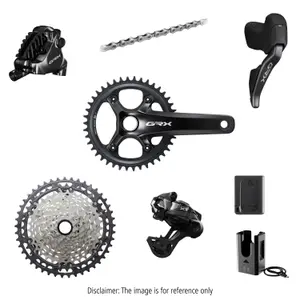


Starting at £1,099.93
£866.53


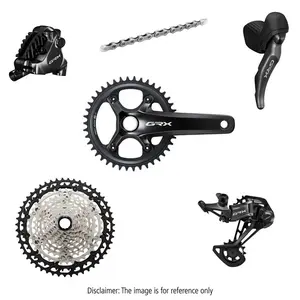


A complete road bike groupset brings together in one order the parts that shift gears and brake: levers, derailleurs, crankset, cassette, chain and brakes, designed to work together. First choose between electronic and mechanical shifting, then the range, the crank length, the chainrings and the cassette. Road and gravel groupsets are presented together on this page.
Why choose a complete groupset?
A groupset brings together the drivetrain and braking parts from the same range: levers, front and rear derailleurs, crankset, cassette, chain, calipers and, depending on the kit, rotors, bottom bracket or battery. It is the solution for building up a bare frame or replacing a worn or older-generation drivetrain in one go. All the parts are designed to work together.
Electronic or mechanical: two ways to shift gears
- Shimano Di2 12-speed: the levers communicate wirelessly, while the derailleurs remain wired to a battery housed in the seatpost.
- Sram AXS: no wires at all, each derailleur carries its own removable battery.
- Campagnolo Super Record 13-speed: wireless shifting with a double chainring.
- Mechanical: cables pulled by the shifters, simple to maintain, mainly found here on gravel groupsets.
Electronic shifting stays consistent, with no cable stretching, and can be adjusted from an app, at the cost of batteries to recharge.
Range, chainrings, cassette and cranks
Each brand tiers its groupsets: 105, Ultegra and Dura-Ace at Shimano, Rival, Force and Red at Sram, Record and Super Record at Campagnolo. The higher up the range, the lower the weight and the more refined the materials. The same groupset then comes in several configurations: 50/34 or 52/36 chainrings, an 11-30 cassette for flat terrain or 11-34 for the mountains, and 170, 172.5 or 175 mm cranks. At Shimano, the letter P at the end of the reference, as in R9270P, denotes a crankset with a power meter.
Compatibility with the frame and wheels
Check three points before ordering. The brakes: most recent groupsets use hydraulic disc brakes with flat mount fitting. The bottom bracket, threaded or press-fit, suited to the frame and to the crank axle. The freehub body of the rear wheel: Shimano HG for Shimano cassettes, XDR for Sram cassettes that start at 10 teeth, N3W for Campagnolo.
Spare parts and gravel groupsets
To replace a single component, see road bike shifters, road bike derailleurs, cranksets and cassettes and chains. For tracks and trails, gravel groupsets favour a single chainring and wider-range cassettes.
Which road groupset brands should you choose?
Shimano offers its 12-speed Di2 groupsets, 105 R7100, Ultegra R8170 and Dura-Ace R9270, the latter two also with a power meter crankset, and for gravel the mechanical GRX 820 and the single-ring GRX 825 Di2.
Campagnolo, the Italian manufacturer from Vicenza, designed with the 13-speed Super Record the first wireless electronic road groupset with a double chainring and 13 sprockets; its cassettes range from 10-29 to 11-36 teeth, and its Ultra Torque crankset turns in a QCK-Tech bottom bracket.
Sram focuses on fully wireless groupsets: the double-chainring Force AXS E1 is available here on its own or bundled with a Hammerhead Karoo GPS bike computer.
Road groupsets on sale
When a groupset generation is replaced, its kits join the road drivetrain outlet; recently listed groupsets are featured in new arrivals. Fitting a complete groupset is best planned over the winter, as Black Friday approaches.
Frequently asked questions
Which road bike groupset should you choose?
105 and Rival cover most needs, from training to sportives; the higher ranges mainly make the bike lighter. Then choose the configuration to suit your terrain: smaller chainrings and a wider cassette for the mountains.
Road groupset or gravel groupset: what is the difference?
A gravel groupset offers smaller chainrings, often a single ring, a wider-range cassette and a rear derailleur that stabilises the chain on rough tracks. A road groupset keeps closer gaps between gears for riding fast on tarmac.
Can an electronic groupset be fitted to any frame?
A fully wireless groupset fits almost any frame, with unused cable ports closed off by blanking plugs. A groupset whose derailleurs are wired to a battery needs a frame designed to route the wires to the seatpost: check with the frame manufacturer.
Can you mix parts from different brands?
Not for the levers and derailleurs, which only communicate with those of their own brand and generation. Cranksets, chains and cassettes can sometimes be combined, but at the risk of less crisp shifting: a complete groupset avoids this trial and error.
What crank length should you choose?
The length fitted as standard, linked to the frame size, is a good starting point: 170 mm, or even less, for smaller riders, 175 mm for taller ones, 172.5 mm in between. A shorter crank makes a high cadence easier and relieves the hips in a low position.