Road bike chainrings: compact, semi-compact, 1x


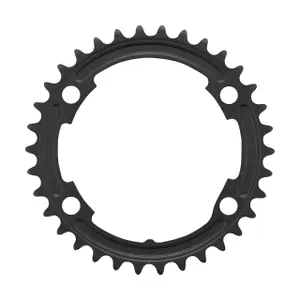


Road bike chainrings are chosen first according to your crankset: number of arms and bolt circle diameter, or direct mount, number of speeds of the chain and position, outer or inner. Then come the teeth: 50/34 for a compact crankset, 52/36 for semi-compact, 53/39 and above for speed, or a single ring for a 1x set-up. Track and oval chainrings are also on this page.
Compact, semi-compact or standard: which chainrings for your road bike?
Together with the cassette, the chainrings determine the gearing, in other words the distance covered with each turn of the cranks. On the road, the double chainring remains the norm, and each combination targets a type of rider.
- Compact 50/34: the combination of compact cranksets, for sportives, the mountains and riders who prefer to spin.
- Semi-compact 52/36: a bigger outer ring to ride fast on the flat, without giving up an easy inner ring on climbs.
- Standard 53/39 or 54/40: the choice of racers and powerful riders.
- Smaller combinations: 48/35 or 46/33 on Sram 12-speed groupsets, paired with a cassette that starts at 10 teeth.
- Single ring: from around 38 to 46 teeth for gravel and some road bikes, with a tooth profile that holds the chain without a front derailleur.
- Triple chainring: on touring bikes and older road cranksets, to be replaced like for like according to its position, inner, middle or outer.
Arms, BCD and direct mount: identifying the fitting
A chainring bolts onto the arms of the right-hand crank, or of its spider. The BCD, for bolt circle diameter, is the diameter of the circle on which the fixing bolts sit; it is usually engraved on the chainring. On the road, there are only a few values to know.
- 130 mm, five arms: older standard cranksets, which do not accept a 34-tooth inner ring.
- 110 mm, five arms: compact cranksets from previous generations.
- 110 mm, four asymmetric arms: recent Shimano road cranksets, from Tiagra to Dura-Ace, which take every combination on the same crank.
- 107 mm, four arms: Sram 12-speed cranksets fitted with a spider.
- Campagnolo four arms: 145 mm for the outer ring and 112 mm for the inner ring on Campagnolo 12-speed cranksets.
- 144 mm, five arms: the standard for track cranksets.
Direct mount, without a spider, fixes the chainring to the crank with splines or bolts: it is only compatible with the crankset brand and model it was designed for.
Outer or inner chainring: ramps, pins and speeds
A double chainset is not just two discs stacked together. The outer chainring carries ramps and pins on its inner face that lift the chain when shifting onto the big ring; their position is timed relative to the original inner ring. That is why a chainring is ordered for a specific combination, 50/34 or 52/36, and for its position. When fitting, the mark or pin provided for the purpose goes behind the crank arm, otherwise shifting suffers.
The number of speeds matters too: with 10, 11, 12 or 13 sprockets, the chain gets narrower and the gap between the chainrings shrinks. Choose a chainring designed for the number of speeds of your drivetrain, and check that the front derailleur can handle the difference in teeth between your two rings.
Oval, aero and big chainrings
An oval chainring lengthens the gearing during the power phase, when your leg pushes hardest, and shortens it when the cranks are almost vertical, where force is lost. Some models can be mounted in several positions to adjust this effect. Aero chainrings close the space between the arms to cut through the air, and big rings of 55 to 60 teeth are used for time trials and triathlon on fast courses. On the track, 144 mm five-arm chainrings are fitted with a 1/8-inch chain, wider than a derailleur chain.
Other road drivetrain parts
To change fitting standard or switch from a triple to a double, you need to change the road crankset. A new chainring goes with a chain in good condition, to be chosen from road bike cassettes and chains, and the front derailleur is set to the height of the new outer ring. To renew the whole drivetrain at once, see road groupsets. For another bike, browse gravel chainrings or MTB chainrings; all models are gathered in bike chainrings.
Which road chainring brands should you choose?
Shimano supplies replacement chainrings for its cranksets, from Tiagra to Dura-Ace. The outer rings of the Dura-Ace R9200 are hollow, a Hollowglide construction that adds stiffness at a reduced weight, and its chainrings carry a two-letter code, NK or NH for example, which refers to the combination they are cut for.
Specialités T.A. designs and makes in France chainrings compatible with Shimano, Sram, Campagnolo and FSA: X110 chainrings for Shimano four-arm cranksets up to Ultegra R8100 and Dura-Ace R9200, Alizé, Hegoa, Syrius or Horus five-arm chainrings, and Full Track track chainrings.
FSA offers replacement chainrings for its K-Force, SLK, Gossamer, Energy, Omega and Vero road cranksets; the WA or WB reference in the name of each chainring identifies the exact part to order.
Stronglight coats its CT2 chainrings, machined from 7075 aluminium, with a Teflon-impregnated ceramic layer that hardens the teeth and smooths contact with the chain; the range covers Shimano, Sram and Campagnolo cranksets, Campagnolo Ekar 13-speed gravel and the track.
Sram has adopted on its 12-speed road groupsets a 107 mm four-bolt fitting and direct mount chainrings: Red, Force and Rival E1 double chainrings, X-Sync narrow-wide chainrings for single-ring set-ups, and versions with an integrated power meter.
Rotor, a Spanish manufacturer, offers its Q-Rings oval chainrings, larger in the power phase and smaller at the dead spots, with several mounting positions to adjust the ovality; they are joined by round chainrings in direct mount or in 110 and 130 mm, and 144 mm track chainrings.
Road chainrings on sale
When a groupset changes generation, its replacement chainrings often join the road drivetrain outlet; references arriving in the catalogue are grouped in new arrivals. During the winter break, Black Friday and then the winter sales leave time to service your drivetrain.
Frequently asked questions
Which chainrings should you choose for road riding?
It all depends on your crankset: the combination fitted as standard, most often compact or semi-compact, is replaced like for like. If you struggle on climbs, a compact 50/34 paired with a cassette whose largest sprocket has 32 or 34 teeth makes things much easier. If you often spin out on the big ring, a 52/36 suits you better.
Can you switch from 53/39 to 50/34 by changing only the chainrings?
Yes on a Shimano crankset with four asymmetric arms, which accepts every combination; you then need to lower the front derailleur and shorten the chain. No on an older 130 mm crankset, whose arms leave no room for a 34-tooth ring: in that case, it is the crankset that needs changing.
Can you fit a chainring from a different brand to your crankset?
Yes, if the fitting, the BCD and the number of speeds match. Several manufacturers offer compatible chainrings for Shimano, Sram or Campagnolo cranksets. Shifting is cleanest with a pair designed together, outer and inner from the same brand.
How do you change a road bike chainring?
On a crankset with arms, the chainring comes off by undoing the fixing bolts and nuts, sometimes after removing the right-hand crank; a direct mount chainring requires the crank to be removed. Place the pin of the outer ring behind the crank arm, tighten in a cross pattern to the stated torque, then set the front derailleur height and check the chain length.
Is an oval chainring worthwhile on the road?
Some riders find a rounder pedal stroke and more traction on climbs, others notice no difference. Allow a period of adjustment, and check compatibility with your front derailleur, which has to follow a non-circular ring.