Road bike saddles: short nose, carbon or comfort




Starting at £202.98
£141.16


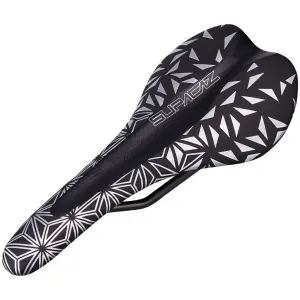
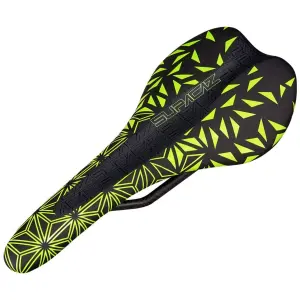
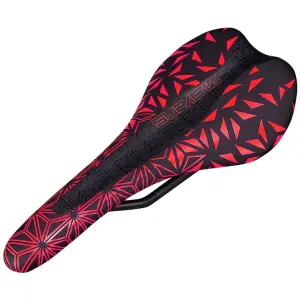
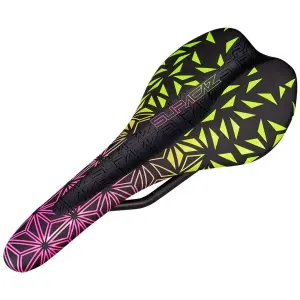
A road bike saddle is chosen according to the width of your sit bones, which sets its width, and the way your pelvis rotates on the bike, which guides its shape and cut-out. Short for a low position, longer and more padded for endurance rides, it is then adjusted to the millimetre. Seat clamps and saddle covers complete the page.
Why does the saddle matter so much in road cycling?
On a road bike, you stay seated for hours, with your upper body leaning towards the handlebar. Your pelvis then rotates forwards: part of the load leaves the sit bones, the two bones you sit on, and shifts towards the front of the saddle. A road saddle must therefore support the sit bones without compressing the central area, stay narrow at the front to let your thighs turn freely, and be firm enough for your energy to go into the pedals rather than into the foam. Padding that is too soft sags under your weight and creates more pressure points than it removes.
Short, classic or endurance saddle: which shape for which position?
- The short nose saddle: a nose shortened by two to three centimetres and a flared rear. It suits low, aerodynamic positions: the pelvis rotates without the nose pressing, and you stay stable when you move forward on the saddle during hard efforts.
- The classic saddle: long and tapered, it lets you slide back on seated climbs or forward to accelerate, and suits more upright positions.
- The endurance saddle: thicker padding and a flat or slightly dipped profile, for sportives and long rides.
- The triathlon and time trial saddle: a cut-off nose or one split into two prongs, for the stretched-out position on aero bars.
The central cut-out, or the channel moulded into the shell, removes material where the load shifts when the pelvis rotates. The lower your position, the more useful it is; in an upright position, a saddle without a cut-out often works just as well.
Rails, shell and padding: what explains the difference in price
Steel rails are sturdy and affordable; titanium or alloy rails make the saddle lighter and filter out a little vibration; carbon rails, often oval in section, save a few more tens of grams but require a seatpost whose clamp accepts that section, tightened to the correct torque. The shell, in fibre-reinforced nylon or carbon, determines how flexible the whole saddle is. Padding is evolving too: foams and gel are joined by 3D-printed structures, made of cells that deform under load and whose density changes from one zone to another.
Height, setback, tilt: setting up a road saddle
For height, the LeMond method gives a good starting point: multiply your inside leg by 0.883 to get the distance between the bottom bracket axle and the top of the saddle, measured along the seat tube. Then fine-tune in steps of a few millimetres. Setback is adjusted by sliding the saddle along its rails: it positions the knee relative to the pedal and spreads your weight between saddle and handlebar. Set the tilt level or very slightly nose-down: a nose that points up compresses the central area, while a saddle tilted too far makes you slide forward and puts weight on your hands. After each change, allow a few rides before adjusting again.
Seatpost, handlebar, stem: the saddle and its surroundings
The saddle works together with the road bike seatpost, whose clamp must accept your rails, and with the handlebar and the stem, which set the distance between saddle and hands. If you are equipping another bike, compare with gravel saddles, MTB saddles or the full range of bike saddles.
Road saddles: the brands available and how to read their ranges
Selle Italia identifies each of its saddles with a letter and a number: S or L depending on whether the distance between your sit bones is under or over 120 mm, then 1, 2 or 3 according to the cut-out, from the closed saddle to the large Superflow opening. Its SLR Boost, 25 mm shorter than the SLR, is available here in several versions.
ISM groups its noseless saddles into families: PN, for Performance Narrow, the narrowest, designed for the stretched-out position of triathlon and time trials, and PS, for Performance Short, which is shorter; in the model code, the first digit refers to the shell and the second to the thickness of the padding.
Selle San Marco flags its central cut-out with the Open-Fit name and offers its models in Sport, Racing or Carbon FX finishes, from steel to carbon rails; the Aspide Short is the shortened version, alongside the Mantra.
Pro, Shimano's component brand, fits its short Stealth 3D saddle with 3D-printed padding, a lattice of cells whose density varies by zone; the Turnix, Griffon and Falcon keep a more classic profile, and the Sirin is designed for women.
Prologo shows its options in the name of each saddle: PAS for the central channel, CPC for the grippy patches that stop you sliding, Tirox for alloy rails and Nack for carbon rails; the Scratch M5 and the Dimension are the most widely available here.
Road saddles on sale
When a saddle maker renews a range, saddles from the previous one join the road components outlet; newly arrived references can be spotted in new arrivals. A saddle is judged over several rides: the winter sales leave time to try another shape before the new season.
Frequently asked questions
Which road bike saddle for long distances?
Choose a saddle whose width matches your sit bones and whose shape suits your position, rather than thick padding. Endurance models add a little foam and a flatter profile, which lets you change position as the hours go by. Test it over several increasingly long rides before an event.
Is a wider saddle more comfortable?
Not necessarily. Too narrow, it leaves the sit bones unsupported and shifts the load onto the central area; too wide, it rubs the inside of your thighs with every pedal stroke. The right width is the one that supports both sit bones, with a margin that depends on how your pelvis rotates.
Should you choose a road saddle with a cut-out?
It is useful if you ride in a low position or feel pressure in the centre of the saddle. The cut-out or channel removes material at that point. If a saddle without a cut-out already suits you, there is no need to change.
Are there road bike saddles for women?
Yes, several brands offer dedicated models, often shorter, with a more open cut-out or an adapted shape. The rule is the same as for men: start from the width of your sit bones and your position. Many women also ride unisex saddles of the right width.
Is a gel saddle cover useful on the road?
It absorbs small vibrations and makes a thin saddle more pleasant on short rides in an upright position. On long, fast rides, it can move and add friction: a well-chosen saddle and bib shorts with a quality chamois do more for comfort.