Flared gravel handlebars, alloy or carbon
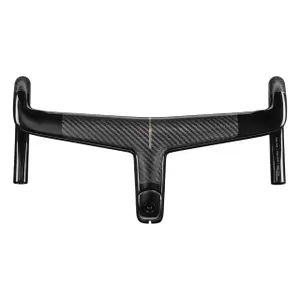
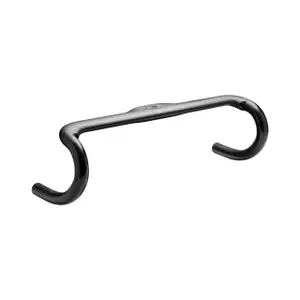

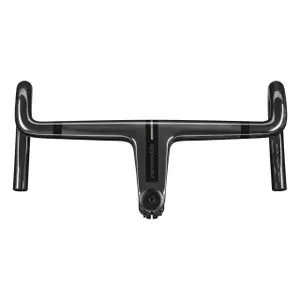


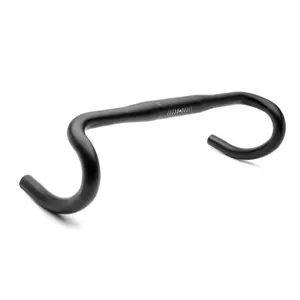
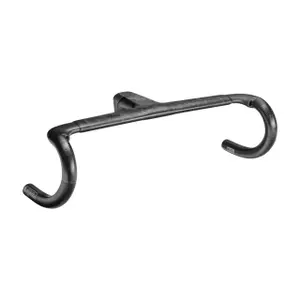


Gravel handlebars look like road drop bars, but their drops splay outwards: this flare widens your grip on rocky descents and leaves room for handlebar bags. Choose them by flare, from a few degrees to more than 20, then by width, reach and drop, and finally by material, aluminium or carbon. This page also includes road handlebars.
Gravel handlebars vs road: what is the difference?
Off-road, you ride more often in the drops, to stay in control on descents and on rutted tracks. Gravel handlebars are shaped for this: their bends splay out to widen the grip and free the wrists, their reach is often shorter and their drop shallower to make the low position comfortable. The tops stay round so you can vary your hand positions, or take a flattened profile, nicer under the palms and more aerodynamic on the road. Gravel handlebars take the same levers as road bars, so you can keep your drivetrain.
Flare, outsweep, reach and drop: reading the geometry
- Flare: the angle at which the whole lower part of the bar opens outwards, lever included. A small flare keeps a position close to the road; beyond 20 degrees, it favours off-road control.
- Outsweep: only the part below the lever splays out, which widens the grip in the drops without tilting the levers.
- Reach: the forward distance between the centre of the bar and the furthest point of the bend. A short reach brings the levers closer and lifts the upper body.
- Drop: the height between the tops and the drops. A shallow drop makes the low position easier to hold for a long time.
How wide should gravel bike handlebars be?
Handlebar width is measured centre to centre, but not always at the same point: some brands give it at the levers, others at the bottom of the drops. With flare, the width in the drops is clearly greater than at the tops. In practice, start from the width of your shoulders and of your current bar: many riders keep the same width at the levers as on the road, others add a few centimetres for extra control and easier breathing. Also think about the room needed for a handlebar bag between the drops.
Aluminium or carbon, round or aero
Aluminium remains the toughest choice and the simplest to fit: it copes better with a crash on stones and takes a bag strapped to the bar. Carbon lightens the front end and allows flattened or aerodynamic profiles, but it requires you to respect the tightening torque and the stem clamping area, generally 31.8 mm. Finally, check internal routing for housing or electric cables if your bike has it.
Flat bars on a gravel bike: possible, under certain conditions
A flat or riser bar gives a more upright position and handling close to that of a mountain bike, popular in bikepacking. The switch does, however, mean replacing the brake levers and gear shifters with flat-bar models, compatible with your callipers and your derailleur, and often adapting the stem. MTB handlebars and the full range of bike handlebars include these models.
Headset, saddle and other gravel components
A comfortable cockpit also depends on the gravel headset, worth checking when you take the stem off. To fine-tune your position, the gravel saddle and the gravel seatpost complete the set-up, and all our gravel components bring these parts together.
Which gravel handlebar brand should you choose?
Pro, a component brand from the Shimano group, dedicates its Discover range to gravel: the Discover 20, in aluminium or carbon, flares out by 20 degrees and pairs with GRX groupsets; an Aero version completes the range.
Zipp combines on its Service Course 70 XPLR and SL-70 XPLR bars a moderate 5-degree flare with an 11-degree outsweep, with 70 mm of reach and 115 mm of drop, to keep the levers almost upright.
Deda offers the Gera, a gravel bar available in carbon, with 16 degrees of flare, and in aluminium, as well as a gravel version of its SuperZero in 6061 alloy.
Funn pushes the flare to 25 degrees on its G-Wide, a triple-butted 6061 aluminium bar with a 130 mm drop, available in 480 and 500 mm widths.
Ritchey gives its VentureMax 24 degrees of flare, here in Comp and RL1 versions, and also offers the Butano and the Beacon among its Comp bars.
Handlebars on sale
Handlebars from a renewed range join the road outlet, which also includes gravel-compatible bars. New models arrive in new arrivals, and the winter sales are a good time to get ready for the gravel season.
Frequently asked questions
How much flare should gravel handlebars have?
For riding mostly on roads and smooth tracks, a small flare, around 5 to 12 degrees, keeps a feel close to the road. For technical tracks or loaded bikepacking, 16 to 25 degrees give more control in the drops, at the cost of a wider position.
Can you fit gravel handlebars on a road bike?
Yes, the clamp diameter and the levers are the same. Just check that the levers do not end up too tilted with a big flare, and that the housing is long enough for the new shape of the bar.
Should you change the stem at the same time as the handlebars?
Not necessarily. If the new bar has a different reach, the position of the levers changes: a stem 10 mm shorter or longer often makes up the difference. A stem riser or spacers can also raise the front end.
Do carbon handlebars absorb vibration better?
A carbon bar can be designed to flex slightly and dampen vibration, but the bar tape, tyre pressure and position often play a bigger part. Carbon mainly brings a weight saving and the freedom of flattened shapes.
How do you set up flared drop bars?
Start from a position where the bottom of the drops is roughly parallel to the ground or tilted slightly backwards, then place the levers so that your wrist stays straight with your hands on the hoods. Tighten the stem bolts in a cross pattern, to the torque stated by the manufacturer.