BMX chains, cogs and freewheels


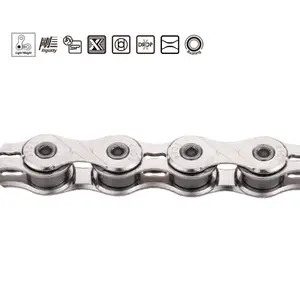
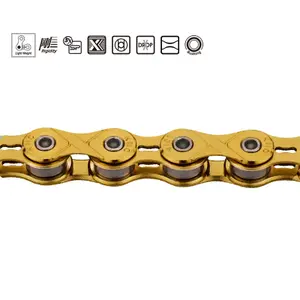


The BMX chain, rear cog and freewheel complete the drivetrain behind the sprocket. Choose the chain to match the width of your sprocket, 1/8 or 3/32 inch, then the cog according to your rear hub: a screw-on freewheel, a cassette hub with a separate cog, or a small driver for freestyle. Race chainrings also feature among the cogs on this page.
How does a BMX rear drivetrain work?
The chain connects the sprocket on the cranks to a single cog fixed to the rear hub. It is this cog that, together with the sprocket, sets the gear ratio, and it is the hub mechanism that lets you stop pedalling without the cranks turning with the wheel. Three systems coexist in BMX: the freewheel screwed onto the hub, the cassette hub, whose body takes a cog or incorporates a small driver, and the freecoaster, reserved for freestyle.
BMX freewheel, cassette or freecoaster: which system?
The freewheel combines the cog and the pawl mechanism in a single part, screwed onto a hub threaded at 1.37 inch with 24 threads per inch. Simple and economical, it is replaced with a dedicated tool and comes in roughly 13 to 22 teeth. Some hubs, known as flip-flop hubs, have a 30 mm metric thread that requires a specific freewheel.
The cassette hub houses the mechanism in the hub body. In racing, it takes a separate cog, often 14 to 18 teeth, that is easy to change; in freestyle, the 9-tooth cog is part of the driver, which allows a 25-tooth sprocket and cranks with plenty of clearance.
The freecoaster lets the wheel roll backwards without driving the pedals: it is what makes fakies and backwards tricks possible. Its clutch has some free play, the slack, which is adjustable on most models and makes it less suited to race starts.
Engagement and number of teeth: choosing your cog
On a start gate, every fraction of a turn lost before the drivetrain drives the wheel counts. The number of points of engagement indicates how many times per turn the mechanism can catch: the higher it is, the more direct the pick-up. A 3-pawl freewheel offers a few dozen points, a 9-pawl racing freewheel nearly a hundred, and sprag clutch hubs, without pawls, engage with no delay.
The number of teeth on the cog has a strong effect on the gear ratio: going from 16 to 15 teeth is equivalent to adding nearly three teeth to a 44-tooth sprocket. The cog is therefore used for big changes, the sprocket for fine adjustments. Finally, check that the cog is compatible with the cassette body, splined according to the manufacturer's standard.
BMX chain: size, half link and length
Two widths exist for the same half-inch pitch: the wide 1/8 inch chain, or 9.5 mm, standard in freestyle and on children's BMX bikes, and the narrow 3/32 inch chain, 7.7 mm, lighter and common in racing. Sprocket, cog and chain must all share the same width.
A BMX has no derailleur to tension the chain: the tension is set by moving the wheel back in the frame's horizontal dropouts. A half-link chain adjusts the length in half-inch rather than one-inch steps, which puts the wheel exactly where you want it. Leave a little slack halfway along: a chain that is too tight drags and wears the drivetrain, a chain that is too loose comes off when you land a jump.
BMX sprockets and cranks
For the chain width and the number of teeth at the front, BMX sprockets give their dimensions; BMX cranks state their drive side, which must match that of the hub. All the parts are grouped in the BMX drivetrain section.
BMX chain, cog and freewheel brands
Excess offers two racing freewheels: the EFW-S, with 3 pawls and 36 points of engagement, and the EFW-SV, with 9 pawls and 96 points, as well as cogs from 13 to 18 teeth.
KMC, a Taiwanese chain maker among the largest in the world, offers its K1 in narrow or wide versions, and the lighter K1SL, with smooth outer plates, for racing.
ACS, founded by aerospace engineers and a pioneer of high-end BMX parts, makes the Paws freewheel: three pawls that engage every 12 degrees, removal with a standard 4-prong tool, and an M30 version for hubs with a metric thread.
Shimano reserves for its DX BMX range the SF-MX30 freewheel, in steel, for 3/32 inch chains, and racing cogs in chromed steel.
Onyx, known for its sprag clutch hubs without pawls, supplies cogs for its Ultra SS body and cogs to the Shimano HG standard, in 7075 aluminium or stainless steel.
Odyssey BMX built its Bluebird chain on a KMC base, with a factory-fitted half link at one end to set the length precisely.
BMX drivetrain deals
Cogs and chains in discontinued colours join our BMX clearance; new arrivals show what has just come in. Black Friday and the winter sales leave time to replace a worn chain and cog before racing starts again.
Frequently asked questions
How do you know if a BMX chain is worn?
A chain stretches with use, as its pins and rollers wear. A chain checker placed on the chain shows whether it has passed the limit. Another sign: the chain lifts off the sprocket teeth when you pull it forwards. A badly worn chain damages the sprocket and cog.
How do you remove a BMX freewheel?
With the wheel out, engage the tool that suits your model, prong or splined, and unscrew anticlockwise. As the freewheel is tightened by pedalling, a vice or a long spanner helps to loosen it. Grease the thread before fitting the new one.
How many links for a BMX chain?
There is no single length: it depends on the number of teeth on the sprocket and cog and on the length of the frame's chainstays. Chains are sold long, around a hundred links, and are shortened with a chain tool while holding the wheel in the desired position.
Can you switch from a freewheel to a cassette hub?
Yes, but you have to change the rear hub, which means rebuilding the wheel or fitting a new one. You gain a stronger hub, access to small cogs and quicker gear changes.
Which rear cog for a BMX race bike?
Race cogs most often range from 14 to 18 teeth, chosen according to the sprocket and the track. Keep a common sprocket size and vary the cog for big changes in gearing, then fine-tune at the front. The cog must have the same width as the chain.