BMX brake cables, gyro cables and housing

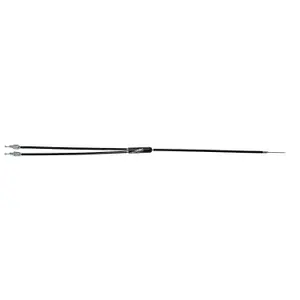


A BMX brake cable connects the lever to the rear brake, either directly or through a gyro that lets the handlebar spin all the way round without tangling the cable. Depending on your set-up, choose a complete cable with its housing, or the upper and lower gyro cables, in the right length. Odyssey, KHE, Eclat and Colony offer their freestyle cables here.
Why a BMX-specific brake cable?
On a freestyle BMX, the rear brake has to keep working during tricks where the handlebar spins, such as the barspin, and the cables take knocks, rubbing and crashes. BMX cables meet these demands with tougher housing, lengths suited to compact frames and, for gyro set-ups, split cables. Many also come in colours.
Gyro or rotor: upper and lower gyro cables
The gyro, also called a rotor or detangler, lets the handlebar turn a full revolution without the rear brake cable winding up. The cable coming from the lever splits into two upper cables, which pass either side of the stem and pull on a plate mounted on a bearing around the steerer. A second plate, free to rotate, carries the two lower cables: they pass through the cable stops on the head tube and join into a single cable to the rear brake.
The upper cable is chosen by length, short, medium or long, according to the height of the handlebar and stem; the lower cable depends mainly on the frame. The front brake, if there is one, can run inside the stem and the fork steerer, thanks to a hollow stem bolt.
BMX brake housing: length and adjustment
Compressionless housing, like that of Linear cables, transmits the force of the lever without compressing: braking stays precise and the cable does not bind when the handlebar turns during tricks. Cut the housing long enough for the handlebar to turn freely without pulling on the brake, but without a needless loop that catches your feet. On a gyro, the two upper cables must have the same tension, as must the two lower cables, so that the plates lift evenly.
BMX brake levers, brakes and gyros
A new cable deserves a BMX brake lever in good condition and a well-adjusted brake caliper; BMX gyros complete freestyle set-ups, and everything is in our BMX brakes. For another bike, see our MTB brake cables or road bike brake cables.
Which BMX brake cable brands to choose?
Odyssey BMX created Linear cables with compressionless housing and the Quik system, which combines the cable and the brake straddle in a single part, with a version adjustable to three lengths; its Gyro 3 cables come in S, M and L sizes.
KHE Bikes offers its Affix cables, upper and lower, in several colours, as well as a double upper cable for gyros, the Dragonfly.
Eclat offers The Core, a 130 cm cable in four colours designed for street as well as park, and the Classic lower gyro cable.
Stolen Brand offers its Whip Linear cable in two finishes.
Colony makes the RX3, a double upper gyro cable available in three lengths, from 360 to 445 mm.
Kink BMX offers the Linear One Piece, a complete cable made in a single piece.
BMX brake cables on sale
End-of-line BMX parts are gathered in our BMX clearance, and the latest references in new arrivals. Keep a cable in reserve: it is quickly changed after a crash.
Frequently asked questions
Which length of upper gyro cable should you choose?
It depends on the height of your handlebar and the position of the gyro: manufacturers generally offer three sizes. Measure your current cable from end to end, or go for the original size; too short, it pulls on the brake when you turn the handlebar, too long, it flaps about.
Do you need a gyro to do barspins?
With a conventional cable-operated rear brake, yes: without a gyro, the cable winds around the stem. The alternatives are a front brake whose cable runs through the steerer, or a BMX with no brakes.
Why does my BMX brake feel spongy?
Most often, the housing is compressing or the cable has slackened. Compressionless housing, a well-tensioned cable and a gyro adjusted flat restore a firm braking feel. Also check brake pad wear.
How do you adjust a BMX gyro?
First adjust the tension of the two upper cables with their barrel adjusters, until the upper plate lifts evenly. Do the same with the lower cables, then adjust the brake. Finally, turn the handlebar a full revolution to check that braking does not vary.
When should you replace a BMX brake cable?
As soon as a strand frays, the cable rusts or the housing is kinked or split after a crash. A cable that slides poorly in its housing makes the lever feel stiff and braking imprecise.