MTB brake callipers: disc, V-brake, cantilever


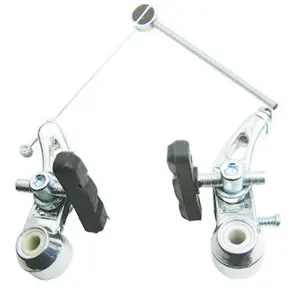
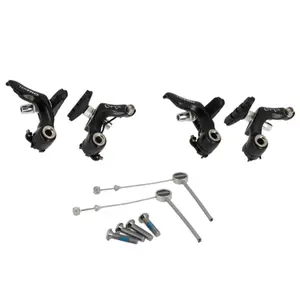


The MTB brake calliper is the part that clamps: on a disc brake, it pushes the pads against the rotor; on a V-brake or a cantilever, its arms squeeze the rim. To replace it, identify the type of brake, then the mount, Post Mount on most mountain bikes, and, for a hydraulic brake, the brand of the lever and its fluid. Complete callipers and spare parts are gathered here.
Disc or rim: which brake calliper for your MTB?
Disc brakes are fitted to the vast majority of mountain bikes: they brake just as hard in mud, without wearing the rim. The V-brake, two long arms bolted to welded bosses, is still common on entry-level mountain bikes, hybrid bikes and children's bikes. The cantilever, an older design, can be recognised by its straddle cable pulled by a cable hanger. A calliper is always replaced by a model from the same family.
Hydraulic or mechanical, two or four pistons: what to check
A cable-operated calliper works with a V-brake lever and needs no bleeding. A hydraulic calliper shares its fluid with the lever: keep the same brand and the same fluid, mineral oil or DOT, two fluids that must never be mixed. Two pistons are enough for cross-country; four give more power and run cooler on long descents.
Post Mount, two bolts 74 mm apart, is the mountain bike standard. Older IS frames, with bolts perpendicular to the wheel, need an adapter, as does a rotor larger than the original one.
How to align an MTB brake calliper that rubs or sticks
A rotor that rubs is recentred with the calliper bolts loosened: squeeze the lever to align the pads, then tighten the two bolts in turn. A piston that stays out is cleaned with soapy water, pads removed, then pushed back with a plastic tyre lever. On a V-brake, the tension screw on each arm balances their spacing.
Which MTB brake calliper brand should you choose?
Alhonga, a Taiwanese maker of braking systems based in Changhua, supplies here a replacement V-brake for mountain bikes and hybrids with rim brakes.
Shimano covers both families: the Alivio V-brake for rims and, for discs, the cable-operated BR-M375, in Post Mount, designed for a V-brake lever.
Elvedes, a Dutch brand of brake parts and cables, offers the MP1000, a two-piston mechanical Post Mount calliper, as well as a Flat Mount calliper.
Formula, an Italian brand from Prato that specialises in brakes and suspension, sells its callipers individually, such as the complete Post Mount front calliper available here.
SRAM, the American group based in Chicago, offers the calliper without hose of its four-piston G2 RS brake, and the banjo fitting for Elixir, X0 and Guide brakes.
Related parts and MTB brakes on sale
A new calliper deserves MTB disc brake pads that match its reference, or rim brake pads for a V-brake. Levers are chosen from our MTB brake levers, and callipers for other types of riding on the gravel brake callipers page. End-of-line items move to the MTB brakes outlet.
Frequently asked questions
Do you need an adapter to fit an MTB brake calliper?
Not on a Post Mount fitting with the original rotor. You need one on an IS mount or for a larger rotor, chosen according to the mount and the new diameter.
Does a mechanical calliper brake less well than a hydraulic one?
It takes more effort and is less easy to modulate, as the cable rubs in its housing. It remains effective for trail riding and is easy to repair; on demanding descents, hydraulic brakes hold up better.
How can you tell if a hydraulic calliper is leaking?
Oily traces around the pistons, contaminated pads or a lever that touches the grip should all ring alarm bells. Replace the contaminated pads and have the calliper checked: depending on the model, it can be repaired with a seal kit or must be replaced.
Can you switch from a V-brake to a disc brake?
You need calliper mounts on the frame and the fork, and hubs ready to take a rotor. Failing that, the conversion means another fork and other wheels.
What is the difference between two and four pistons?
Four pistons press on a longer pad: braking gains in power and endurance. Two pistons weigh less. The pads are not interchangeable between the two.